




LiThink Guide · Transparency & Sustainability
EU Battery Passport 2027: What LiFePO₄ Battery Buyers Need to Know
A battery often powers everyday life in a motorhome, on a boat or in a solar system for many years. The digital EU battery passport aims to make important information about certain batteries more accessible, from the product and its materials to its subsequent use and recovery.
From 18 February 2027, this digital record will be mandatory for certain batteries newly placed on the market or put into service. Buyers of LiFePO₄ batteries should therefore take a closer look: Which models are covered, what can a QR code reveal, and which details actually help with a purchase decision?
01 / The legal framework
What is the EU battery passport?
The battery passport is an electronic record that brings together information about a battery model and an individual battery. It is based on the EU Battery Regulation (EU) 2023/1542, in particular Articles 77 and 78 and Annex XIII. The regulation considers batteries throughout their life cycle: manufacture, use, further use and disposal are all connected.
A typical product page describes a model. A battery passport goes further because it is linked to a specific battery. This allows general product characteristics and individual information to be considered separately. This can be particularly helpful if a battery is later inspected, resold, repurposed for another application or recycled.
Understanding the key dates
This phased timeline is important: the introduction of the battery passport is not a shared start date for all environmental, labelling and material requirements. If you read a claim such as "fully sustainability-certified from 2027", ask which specific obligation and evidence it refers to.

02 / Categories and capacity
Which LiFePO₄ batteries are affected?
Cell chemistry alone does not determine whether a passport is required. LiFePO₄ refers to lithium iron phosphate; the battery category and energy content also matter for legal classification. Article 77 covers industrial batteries over 2 kWh, as well as electric vehicle batteries and batteries for light means of transport, such as certain e-bike batteries. For the latter two categories, the passport requirement does not depend on the 2-kWh threshold.
A privately used leisure battery can also legally be classified as an industrial battery. The term is broader than a battery used in a factory. The category should therefore be determined based on the specific product and its intended use. The label "motorhome battery" or "solar battery" alone does not answer this question.
From amp-hours to kilowatt-hours
LiFePO₄ battery product names often include 12 V or 24 V. To estimate the energy content, you need the model's actual nominal voltage. Typical values are 12.8 V and 25.6 V respectively. The calculation is: Nominal voltage × capacity in Ah ÷ 1,000 = nominal energy in kWh.
| Example | Nominal energy | Threshold assessment |
|---|---|---|
| 12.8 V / 100 Ah | 1.280 kWh | Under 2 kWh |
| 12.8 V / 165 Ah | 2.112 kWh | Over 2 kWh |
| 12.8 V / 280 Ah | 3.584 kWh | Over 2 kWh |
| 12.8 V / 334 Ah | 4.2752 kWh | Over 2 kWh |
| 25.6 V / 100 Ah | 2.560 kWh | Over 2 kWh |
If classified as an industrial battery, "more than 2 kWh" is the relevant threshold. Exactly 2 kWh is not more than 2 kWh. The table does not replace the manufacturer's specifications or an assessment of the battery category.
For a system with multiple batteries, you should also clarify which product is legally placed on the market as a battery. Adding up all the energy storage in the vehicle is not a reliable substitute for this product classification. For a planned system, ask for the relevant model and system documentation.

03 / Information with practical value
What information does the digital battery passport contain?
The information structure is governed by Annex XIII. Depending on the applicable requirements, it includes details about the battery's identity, materials, performance, durability and circularity. For buyers, the key considerations are whether the information clearly matches the product, is explained in an understandable way and can be compared with other products.
Product identity
Manufacturer and model information helps link the product description, labelling and documentation. This makes it easier to spot mix-ups between similarly named variants.
Materials
Information about chemical composition and relevant substances makes it clearer what type of battery it is and what needs to be considered during treatment and recovery.
Performance and durability
Technical specifications are meaningful only when their conditions are stated. Pay attention to temperature, depth of discharge and test conditions when comparing lifespan or performance figures.
Circularity
Relevant information can help specialists better prepare for further use, refurbishment or recovery. However, this does not mean the battery is automatically approved for every second-life application.
Why a fixed number of data fields tells you little
You may encounter different data point counts in various summaries. These counts can result from technical implementations or different ways of dividing individual requirements. A fixed number such as "71 data points" is therefore not an adequate description of the legal obligations for every product. What matters is the applicable requirements and whether they apply to the category in question.
The amount of data alone is not a measure of quality. A clearly identified data sheet with understandable units is more useful for a purchase decision than a long list without test conditions. In particular, check whether capacity, energy, current limits and temperature specifications all refer to the same model variant.
04 / Scan and understand
QR codes and access rights: Who can see what?
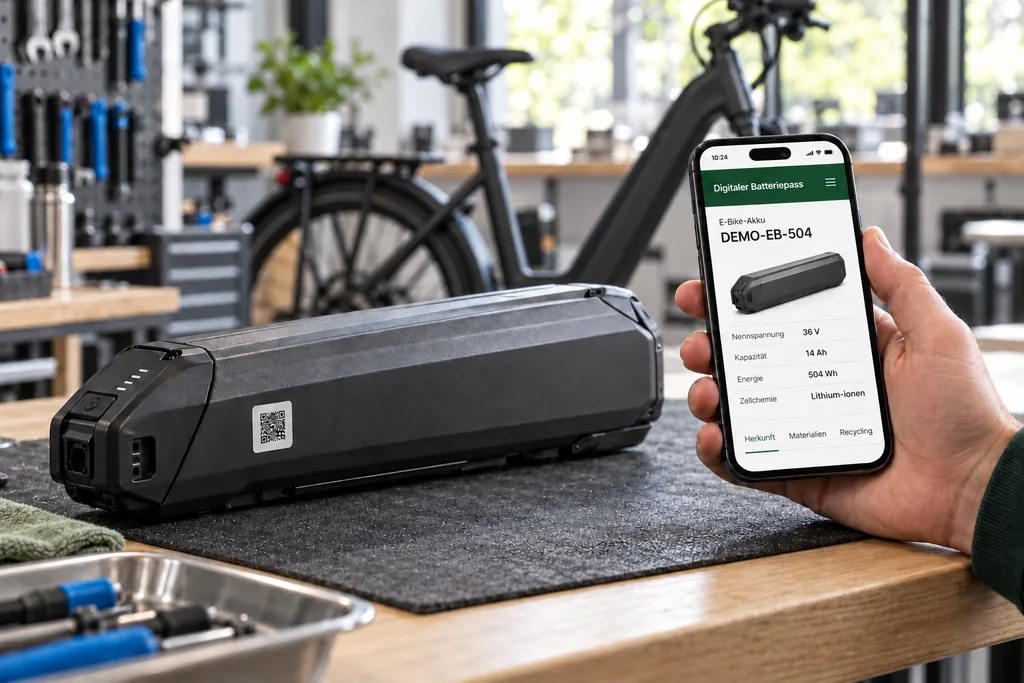
The QR code provides access to the digital passport. It points to a unique identifier for the individual battery. A label that merely opens a general shop page or user manual does not in itself prove that a battery passport exists. Check whether the model and its individual identification are clear.
The information is not entirely public. The regulation distinguishes between publicly accessible data, specific access for competent authorities and access for people with a legitimate interest. Which protected details are accessible depends on the relevant authorisation and intended purpose.
Accessible product and sustainability information helps users understand and compare products.
Market surveillance authorities, the Commission and notified bodies receive the access required for their duties.
Certain additional data supports designated activities, such as repair, refurbishment or recycling.
As an owner, you do not automatically receive all detailed technical data. A digital passport also does not mean that the battery transmits its location or must be constantly connected to the internet. A Bluetooth app for local battery monitoring and a digital battery passport serve different purposes.
How to check information after scanning
- Check the identification: Do the manufacturer, model and identifier match the product?
- Compare the specifications: Do the nominal voltage, capacity and energy match the data sheet and invoice?
- Read the context: Which test conditions and validity details explain the values?
- Resolve any uncertainties: Ask the supplier if the link is missing or the information is inconsistent.

05 / Motorhomes, boats and solar
What does the battery passport mean for everyday use?
In a motorhome: An understandable power supply
For a longer stay without shore power, the first question is practical: Is there enough available energy for the devices you plan to use? Compare your energy needs with the usable energy and current limits of the system. A battery passport can help identify the product; it does not calculate how long you can stay off-grid or whether an existing charging booster is suitable.
Keep installation documents, settings and proof of purchase as well. If you change vehicles or troubleshoot a fault, these documents help explain the actual setup. The digital record complements clear installation documentation.
On a boat: Operating conditions remain crucial
For electrical devices or a suitable trolling motor, permissible currents, charging conditions and installation location all matter. Moisture protection, mounting and electrical design must suit the intended use. A battery passport is not a general approval for every marine application and does not by itself indicate suitability as a starter battery.
In a solar system: Consider technical and environmental information together
For a solar application, the battery voltage, charge controller, inverter and intended wiring must be compatible. Clear environmental information can also be helpful when comparing different options. Technical selection remains a separate task, however: a well-documented battery must also meet the system's electrical requirements.

Comparing carbon footprints and recycled content correctly
The battery passport brings information together, while individual substantive obligations follow their own rules and timelines. Carbon footprint declarations, performance classes and recycled content information should therefore not be presented as universally mandatory at the same time from February 2027. Their specific applicability depends on factors including the battery category and supplementary legal acts.
When comparing environmental claims, ask about the reference unit and the method used. A single carbon footprint figure without context is difficult to assess meaningfully. Also distinguish between the proportion of already recycled materials in a new battery and the subsequent recovery of materials from a waste battery. These are different matters.
The EU rules published in 2025 for calculating and verifying recycling efficiency and material recovery show that better data and transparent recovery go hand in hand. For consumers, the practical step at the end of a battery's useful life is to return it through appropriate collection or take-back systems.
06 / An informed purchase decision
What to look for in a battery brand today
A forward-thinking supplier should be able to answer specific questions about its product. General claims about being future-proof are less useful than clear documentation. Use the following points to assess technical suitability and documentation together.
- Clear specifications: Can the model, nominal voltage, capacity, energy and operating limits be clearly identified?
- Suitable charging conditions: Are the charging profile, permissible temperatures and, where applicable, the conditions for a heating function described?
- Clear BMS information: Are continuous current, peak current and protection functions explained separately?
- Available documentation: Is there a clear manual and relevant conformity information for the specific product?
- Clear support: Are contacts, warranty terms and the process for technical questions readily accessible?
- Specific battery passport information: For a product covered by the requirement, is it explained how the legally required information will be provided?
An in-house developed BMS can be a technical feature, but it is not independent proof of battery passport compliance. The same applies to a long warranty or CE marking: these serve different purposes. For a warranty, check the scope, conditions and claims process in particular.
07 / LiThink for your application
Choosing LiFePO₄ batteries with the right specifications
At LiThink, selection starts with your application: energy needs, installation space, permissible currents and charging options should all be considered together. On our European website, you can find product information on LiFePO₄ batteries for different power systems. Always check the specifications for the exact variant.
One example is the 12V 334Ah Mini Pro. With a nominal voltage of 12.8 V and 334 Ah, it has a nominal energy of 4,275.2 Wh. This puts it above 2 kWh by calculation. Its battery category and the date it is placed on the market or put into service are also relevant to the legal passport requirement.

Power for suitable applications
LiThink 12V 334Ah Mini Pro
A large energy reserve for a suitably designed motorhome, boat or solar system. Compare the technical limits with your planned installation.
- 12.8 V nominal voltage / 334 Ah
- 4,275.2 Wh nominal energy
- Bluetooth monitoring and self-heating according to the product description
Planning a different system voltage? Explore our 24V LiFePO₄ series too. The key is that the battery and the rest of the system are compatible. A higher voltage or greater energy content alone is not a reason to modify an existing system.
08 / Frequently asked questions
FAQ: EU battery passport for consumers
Do I need to apply for a passport for a battery I already use?
The battery passport rule does not create a general obligation to retrofit passports for batteries already in private use. The obligation applies when covered batteries are placed on the market or put into service from the specified date. You therefore do not need to replace your existing battery solely because of the passport.
Is every battery bought from existing stock after February 2027 automatically covered?
The purchase date alone is not decisive. What matters in particular is when the specific battery was first made available on the EU market. For older stock, the supplier should be able to explain the classification clearly. The manufacturing date and the date it was first placed on the market are not the same.
Do all 12V LiFePO₄ batteries require a passport?
No. The sales description "12V" tells you neither the category nor the energy content. Check the nominal voltage and Ah value. For industrial batteries, the threshold of more than 2 kWh is relevant; other categories have their own applicable rules.
Do I have to create or pay for the battery passport myself?
The economic operator responsible under the regulation is in charge of the passport. Consumers should be able to access the information free of charge in accordance with their access rights. An ordinary purchase does not make you the operator of the passport system.
Does the battery passport replace the Bluetooth app?
No. A battery app can display current operating information if the product supports it. The battery passport provides mandatory information digitally. The data available in each system must be checked for the specific product.
Does the passport guarantee a higher resale value?
Better documentation can help with valuation. It does not guarantee a specific residual value. Age, condition, use, available capacity and suitability for the next application remain decisive. When buying a used battery, a professional condition assessment is still advisable.
What happens when a battery is repurposed or recycled?
A new battery passport linked to the original passport is required for the refurbishment and repurposing steps specified in Article 77. The battery passport ceases to exist after recycling. Therefore, hand over a waste battery to an appropriate take-back or recovery facility and do not open it yourself.
Greater transparency for a long-term decision
The EU battery passport establishes a binding framework for more accessible battery information. Its practical value comes from using that information alongside technical specifications, clear documentation and suitable system planning. This helps you make a more informed choice of LiFePO₄ battery and better understand it throughout its useful life.
Before buying, compare the specific battery with your needs. At LiThink, you can find product specifications and further information on the relevant product pages.
Share:
LiThink Black Friday 2026: Lowest Prices on LiFePO₄ Batteries