




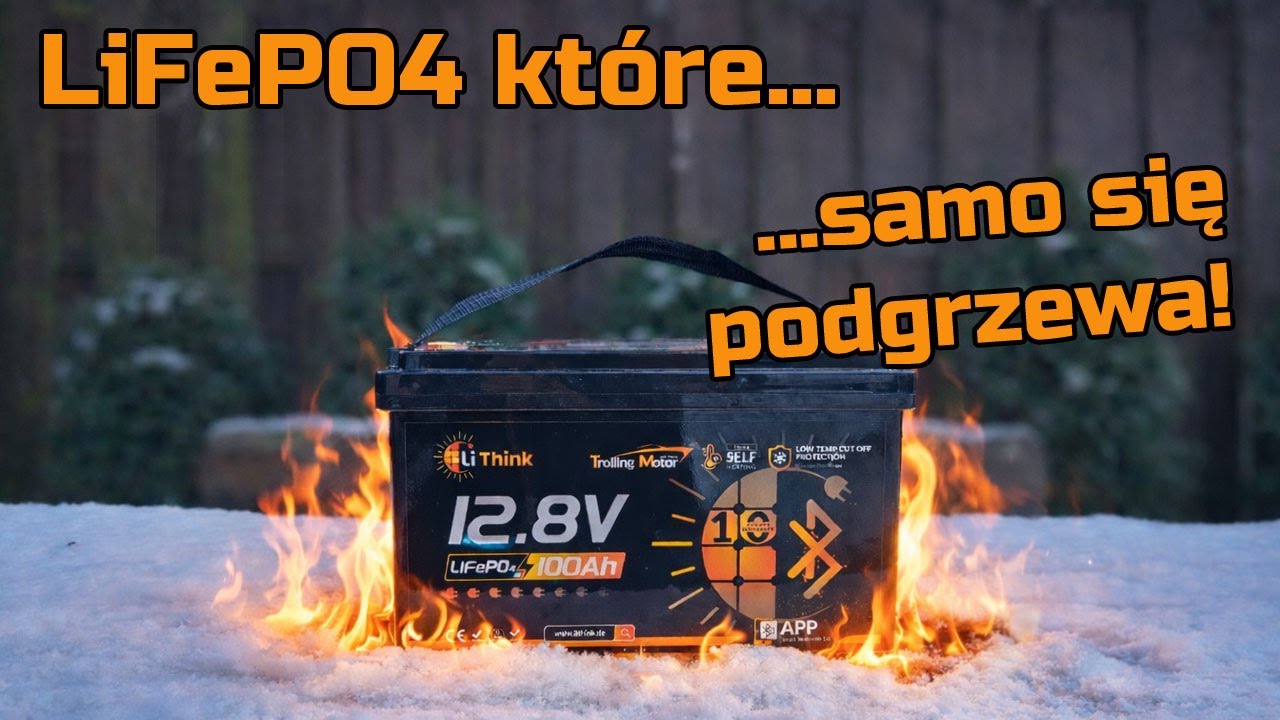
How does a LiThink 12,8V 100Ah LiFePO₄ battery with Bluetooth and self-heating perform in the cold, under heavy loads and in a real capacity test?
YouTuber Krzysiek Raus set out to find out. Rather than relying solely on the manufacturer's specifications, he tested the battery at low temperatures, opened the case, checked the Bluetooth app, performed a full capacity test and then subjected the battery to loads exceeding 2.000 Watt.
The video "LiFePO4 with Heating Mats - LiThink 100AH Bluetooth - TEST" focuses on one key question: How useful is the integrated self-heating in winter, and does the battery live up to its specifications under heavy loads?
1. What was tested?
The video focuses on a LiThink LiFePO₄ battery with 12,8V and 100Ah. The tested unit features Bluetooth, automatic heating and a 120A BMS as specified in the video.
The battery is particularly interesting for applications where low temperatures are a factor. The tester mentions use on fishing boats and with trolling motors, where a battery may be stored for extended periods in a cold boathouse or outdoors.
At the beginning of the video, Krzysiek explains that LiThink provided the battery for the collaboration. He also emphasises that there was no prescribed script and that he was free to raise critical points during the test.
2. Specifications of the tested model
Alongside the 100Ah capacity, the BMS stands out in the video. While many 100Ah LiFePO₄ batteries are rated for around 100A continuous discharge according to the tester, the tested LiThink model is described as having a 120A continuous current rating.
At 12,8V, that works out to a continuous output of approximately 1.536 Watt. The manual also specifies various short-term current limits.
120A continuous
According to the manual, the battery tested in the video is rated for a continuous discharge current of 120A.
200A
The manual shown in the video specifies up to 200A for ten seconds for short load peaks.
500A
For very brief peak loads, the manual specifies up to 500A for one second.
The tester also measures a weight of approximately 11,1 kg. The dimensions are described in the video as approximately 34 × 19,5 × 22 cm.
This blog describes the unit tested in the video. LiThink continuously develops its products, so the specifications of the currently available model may differ from the version shown in the video.
3. Self-heating cold test
Self-heating is the central focus of the video. Before the test, the battery was stored outside for several hours until its internal temperature had fallen below 5°C.
According to the manual used in the test, the heating operates differently depending on the cell temperature:
In this temperature range, the heating function starts while a small portion of the charging power can already flow into the battery.
At even lower temperatures, the explanation states that heating takes place first, before charging begins.
Once the battery reaches approximately 15°C, it stops heating and can use all available charging power to charge.
According to the video, the heating mats require approximately 117 Watt. Since the tester used a 10A charger, almost all of the charging power initially went to the heating system.
The heating function worked as intended in the test
With an outside temperature around 0°C, the internal battery temperature rose to approximately 15°C within around 13 minutes. The heating then stopped, allowing the 10A charger to use virtually its full output for charging.
Using a thermal imaging camera, the tester could also see that the heating areas inside had indeed activated.
For boats, outdoor installations or other applications where a LiFePO₄ battery is stored in the cold during winter, this function can make a difference: the battery does not need to be manually moved into a warm room before charging.
4. Bluetooth app in practice
The battery has Bluetooth and can be connected to the LiThink app. During the test, Krzysiek uses the app to monitor the battery directly throughout the heating, charging and load tests.
SOC, voltage and current
State of charge, battery voltage, current flow and current power can be monitored directly in the app.
Temperature monitoring
During the heating test in particular, the rising internal temperature could be observed directly on a smartphone.
Cell voltages
The app also clearly displays the individual cell voltages and other battery data.
The app also includes switches for charging and discharging. The tester describes the app as simple, clean and easy to navigate.
The Bluetooth connection was more than just an extra feature. Throughout the video, it was actively used to monitor temperature, power, remaining capacity and BMS behaviour under heavy loads.
5. Inside the battery
An unusual part of the video is the opening of the battery case. Many LiFePO₄ batteries are glued shut and difficult to open without damage. On the tested LiThink model, however, the lid is secured with screws.
After removing the covers and screws, Krzysiek was able to take a direct look at the internal construction.
EVA-like padding
The tester notes plenty of padding around the cells, intended to reduce mechanical movement and vibrations.
Heating mats around the cells
Yellowish heating elements or heating mats are visible inside the open case, arranged around the cell block.
Mechanical enclosure
The cell block sits in a sturdy internal structure, which the tester describes as looking solid overall.
The tester makes it clear that this was the first LiFePO₄ battery he had opened himself, so he presents the internal construction rather than giving a definitive technical assessment.
6. Real-world capacity test
The heating test is followed by one of the most important parts of the video: the actual usable capacity.
The battery was fully charged and then discharged using an electronic load. The aim was to check whether the battery rated at 100Ah actually reaches that capacity in practice.
The rated capacity was reached and exceeded
Before the tester had fully discharged the battery to the point of BMS shutdown, the meter already showed more than 101Ah. He then deliberately ended the test, as the rated capacity had clearly been reached.
7. Load test above 2.000 Watt
After checking the capacity and heating function, it was time to test the load limits of the BMS.
For the test, Krzysiek used an inverter and a heat gun with two power settings.
Around 1.050 Watt
The system ran stably at approximately 1kW. The app showed approximately 1.047 Watt of power.
Above 2.200 Watt
More than 2.200 Watt was reached briefly – well above the normal continuous output of the tested 120A system.
Protective shutdown
After the specified overload period, the BMS disconnected the load and automatically restored operation after a short wait.
On a second attempt, the battery sustained the heavy load for approximately the short-term duration specified in the manual before the protection triggered again.
The test shows not only that high power output is possible for short periods. Equally important, the BMS intervenes in the event of an overload and the system then recovers.
The tester also ran the battery at approximately 1kW for around ten minutes. Afterwards, the internal temperature measured by the app was only around 18°C, and the system continued to operate stably.
8. Practical test with a 3D printer
To finish, Krzysiek wanted to use the battery in a real everyday scenario rather than relying solely on electronic loads.
He used an inverter to power a Creality K2 Plus 3D printer. While heating up, the printer can briefly draw approximately 1.200 Watt, while consumption during printing is considerably lower.
35% capacity remaining after printing
According to the video, the test started with approximately 82% battery charge. After a successful print lasting two hours and 42 minutes, the app showed approximately 35% capacity remaining.
The test therefore demonstrated not only a brief high load, but also a longer period of practical power supply with varying power consumption.
9. Test conclusion
Krzysiek gives the battery a positive overall assessment at the end of the video. He particularly highlights the capacity achieved, the effective self-heating, Bluetooth monitoring and the high load capacity of the tested 120A BMS.
In his view, the biggest benefit of the heating function is apparent when the battery is not kept permanently in a warm indoor space, but is instead used on a boat or in another cold environment.
Real-world capacity
The rated 100Ah capacity was reached and slightly exceeded in the practical discharge test.
Self-heating
When the battery was cold, the system automatically warmed the cells and then switched to full charging power.
Load capacity
High continuous loads ran stably, while the BMS performed a controlled shutdown during overload and reactivated afterwards.
Watch the full test
In Krzysiek Raus's video, you can see the complete heating test, the Bluetooth app, the opened battery, the capacity test and the load tests in practice.
The video test refers to the 100Ah model with a 120A BMS tested at the time. Specifications and features of the currently available LiThink model may differ due to ongoing product development. Please refer to the current information on the product page.
An independent hands-on test rather than a simple specification comparison
This test is particularly interesting because several battery features were actually checked in practice: cold start of the heating function, real-world capacity, Bluetooth monitoring, internal construction, high loads and extended use powering a real device.
The video therefore provides a much more comprehensive picture of how a self-heating LiFePO₄ battery performs under real-world conditions.
Share:
LiThink 12,8V 280Ah LiFePO₄ Battery Review: An In-Depth Look Inside
LiThink 12V 280Ah LiFePO₄ Review: Setup, App & Real-World Use